
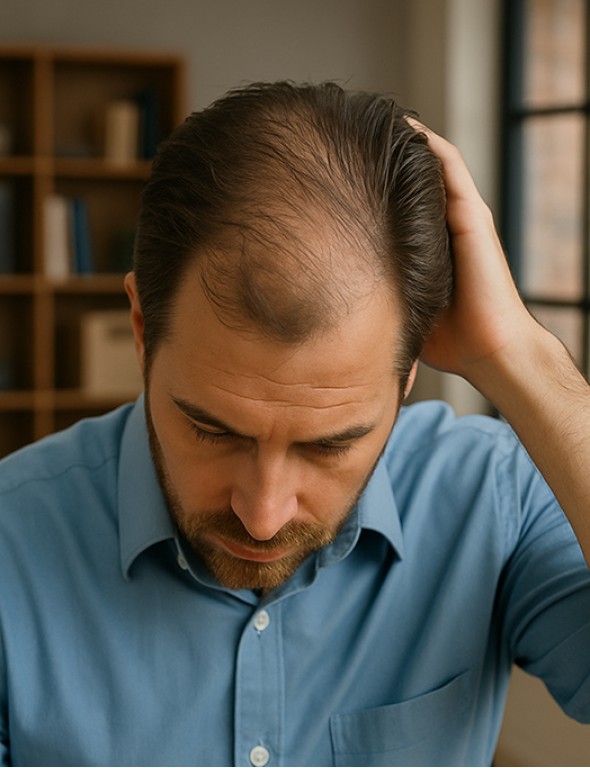
Hair Loss in Men: The 6 Most Common Causes and How to Tell Them Apart
1. Androgenetic Alopecia (Male Pattern Baldness)
This is the most common cause. It’s driven by genetics and the hair follicle’s sensitivity to DHT.
It typically begins at the temples, crown, or with a gradual thinning across the top.
How to recognize it
– Slow, progressive evolution
– Hair becomes finer before it falls
– Often a family history
Treatment options
Minoxidil, finasteride/dutasteride, PRP or mesotherapy, and in more advanced cases, FUE hair transplantation.
It doesn’t come in “episodes”: if untreated, it tends to progress, even if slowly.
2. Telogen Effluvium (Sudden Shedding)
Here the issue is not genetics but a physiological “shock”: stress, infections, fever, surgery, strict diets, low iron, sleep problems…
How to recognize it
– Sudden, noticeable shedding
– Hairs fall out whole (no miniaturization)
– Lasts weeks to a few months
– Does not typically create new receding areas
Treatment
Address the cause, improve habits, and sometimes use minoxidil to speed recovery.
The good part: it doesn’t cause permanent baldness.
The bad part: it can reveal an underlying androgenetic alopecia.
3. Seborrheic Dermatitis
An inflammatory condition of the scalp often linked to excess sebum. It doesn’t cause permanent baldness, but it can worsen ongoing shedding.
How to recognize it
– Oily dandruff
– Itching
– Redness or irritation
– Greasy scalp sensation
Treatment
Specific shampoos (like ketoconazole), sebum control, and avoiding irritating products.
4. Alopecia Areata
An autoimmune condition where the immune system suddenly “switches off” certain follicles.
How to recognize it
– Round, sharply defined patches
– Smooth, hairless skin
– Can affect beard or eyebrows
Treatment
Topical steroids, minoxidil, and immunomodulatory therapies in more extensive cases.
Always requires medical evaluation.
5. Nutritional Deficiencies and Hormonal Imbalances
More common than most people think. Hair is highly sensitive to internal changes.
Possible causes
– Low iron or ferritin
– Vitamin D deficiency
– Thyroid dysfunction
– Low protein intake
How to recognize it
– Diffuse thinning
– Weaker, duller hair
– Associated symptoms like fatigue or weight changes
Treatment
A complete blood test and targeted supplementation.
Random supplements rarely work.
6. External Factors and Lifestyle Habits
Certain medications, smoking, chronic lack of sleep, long-term stress, or extreme diets can weaken the hair cycle.
How to recognize it
– Moderate but persistent shedding
– Fragile, breakable hair
– Flare-ups during stress or insomnia
Treatment
Review habits, adjust medications when possible, and support the follicle with medical therapies.
When to See a Specialist
– Hair loss lasting more than 3 months
– Noticeable thinning in specific areas
– Round bald patches
– Strong family history
– If you're unsure whether you need treatment
A proper diagnosis saves time, money, and frustration.
Hair loss isn’t one single problem with one single solution.
Genetics, stress, inflammation, nutritional issues, and lifestyle all play a role.
Understanding what’s happening in your case is the first step toward choosing the right treatment.
If you’re noticing changes in your hair or want a complete medical and surgical assessment, I can help you find the best treatment plan for your situation.